

Does your roof have storm damage? Is the insurance company only trying to pay for patchwork or a partial roof replacement?
So, you filled an insurance claim for your storm-damaged roof in Tennessee. But your insurance company is only approving partial work that's guaranteed to create a patchy look.
You can hang your head and accept the insurance company’s decision. Or you could do research and talk to a local Tennessee roofing contractor to learn if there are options.
If you do this, you'll probably hear about Tennessee’s matching law. But what is the matching law? Can it be used for your roof damage claim?
For over 35 years, Bill Ragan Roofing has educated homeowners about all the options available for their roof damage insurance claim. So, let's break down everything you need to know about Tennessee's matching law and how to utilize it.
By the end of this article, you'll learn the answers to:
- What is Tennessee’s matching law?
- How does Tennessee's matching law work?
- What does the matching law mean to your roof damage claim?
- How do you utilize the matching law for your roof damage insurance claim?
What is Tennessee’s matching law?
Starting on 10/09/17, a new addendum was added to the Unfair Claim Practices Filing in Tennessee.
0780-01-05-.10(1)(b) of the Unfair Claim Practices Filing states:
"When a loss requires replacement of items and the replaced items do not match in quality, color, or size, the insurer shall replace items so as to conform to a reasonably uniform appearance according to the applicable policy provisions. This applies to interior and exterior losses. The insured shall not bear any cost over the applicable deductible, if any."
This filing prevents insurance company from patching up or putting band aids on damaged homes that create unsightly appearances. Instead, they have to replace the damaged areas and surrounding areas for a uniform appearance.
How does Tennessee's matching law work?
So, Tennessee' matching law means the insurance company must pay for everything to match in appearance on an insurance claim. Let's see it action with a basic example.
Let’s say you have water damage on your ceiling in the living room. Not only does the ceiling drywall need to be repaired but also repainted.
Well, the living room ceiling is connected to the hallway through the dining room and the kitchen. Because of the matching law, they have to paint the whole ceiling, from the living room all the way to the kitchen, so that it matches in appearance.
At the end of the day, if you have damage to the interior or exterior of your home, the insurance company must pay to match the surrounding areas in appearance.
What does the matching law mean to your roof damage claim?
Now you know what the matching law is, let's break down how it works on an insurance claim for roof damage. For a storm-damaged roof, the matching law goes into effect when there are no shingles available that match the current roof shingle’s color to create a uniform appearance.
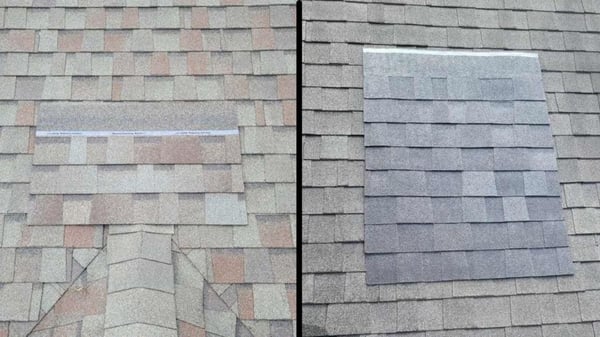 (Shingle color match and mismatch examples)
The shingle or specific color may no longer available, discontinued, or out of production. Even if you can find the shingle, the color might not match because of the wear and tear your roof has gone through.
So, if there are no shingles that match up perfectly and you have an RCV policy, the insurance company will have to pay to replace your roof.
How do you utilize the matching law for your roof damage insurance claim?
Even with the clear matching rules in Tennessee, some insurance companies and adjusters won’t be straightforward with homeowners about it. Maybe they don’t know the local laws, hope you'll give up, or won't have a roofer with insurance experience.
However, the best way to utilize the shingle matching law is by getting an ITEL report from ITEL Laboratories Inc (now part of Nearmap). They analyze and match building materials, including cabinets, siding, flooring, roofing, and more.
For roofing specifically, a current shingle is pulled a roof to identify the shingle, color, and manufacturer. After analyzing the sample, they’ll provide the brand and specific color of the shingle currently installed on your roof and if it's still in production.
If the shingles are discontinued or don’t match your current roof’s color, that’s when the matching law comes into play. But remember, some insurance policies exclude matching laws and it's only able be used on RCV polices.
So, before starting the ITEL process, make sure to go over your policy and any exclusions it may have.
What does the ITEL report process look like?
Now you know what the Tennessee’s matching law is, what it means for roofing, and how it's utilized with an ITEL report. As I've said, your policy must be an RCV policy and there can be no matching exclusions.
So, make sure you show your roofer your policy and insurance paperwork before determining if matching is a possibility. However, getting an ITEL report is an entire process.
In fact, a roofer has to follow the process correctly and do things a certain way to get things approved. That's why I wrote another article breaking down the ITEL process step-by-step.
Check out What is an ITEL Report for a Roof Damage Insurance Claim to learn everything you need to know about getting an ITEL report.